

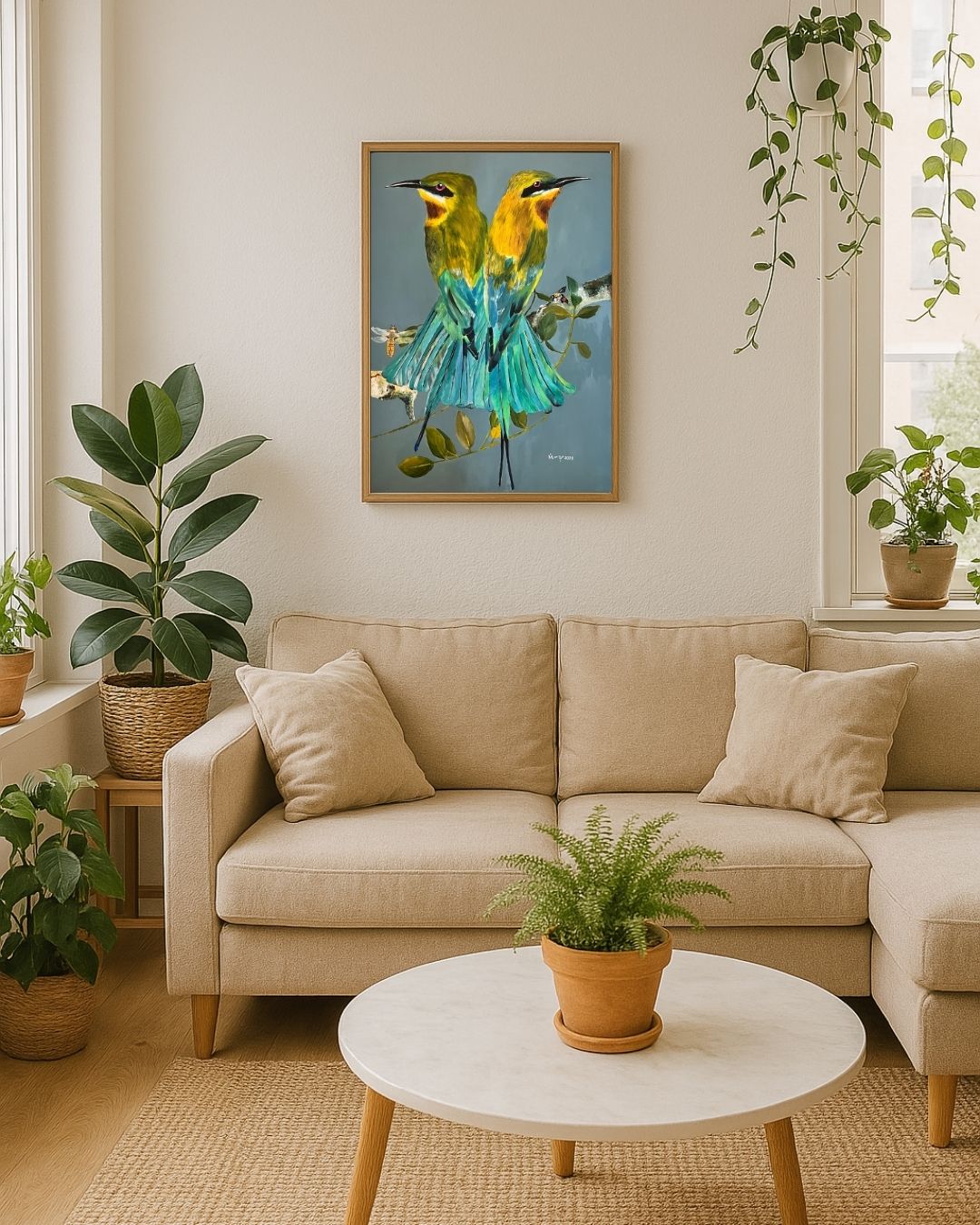
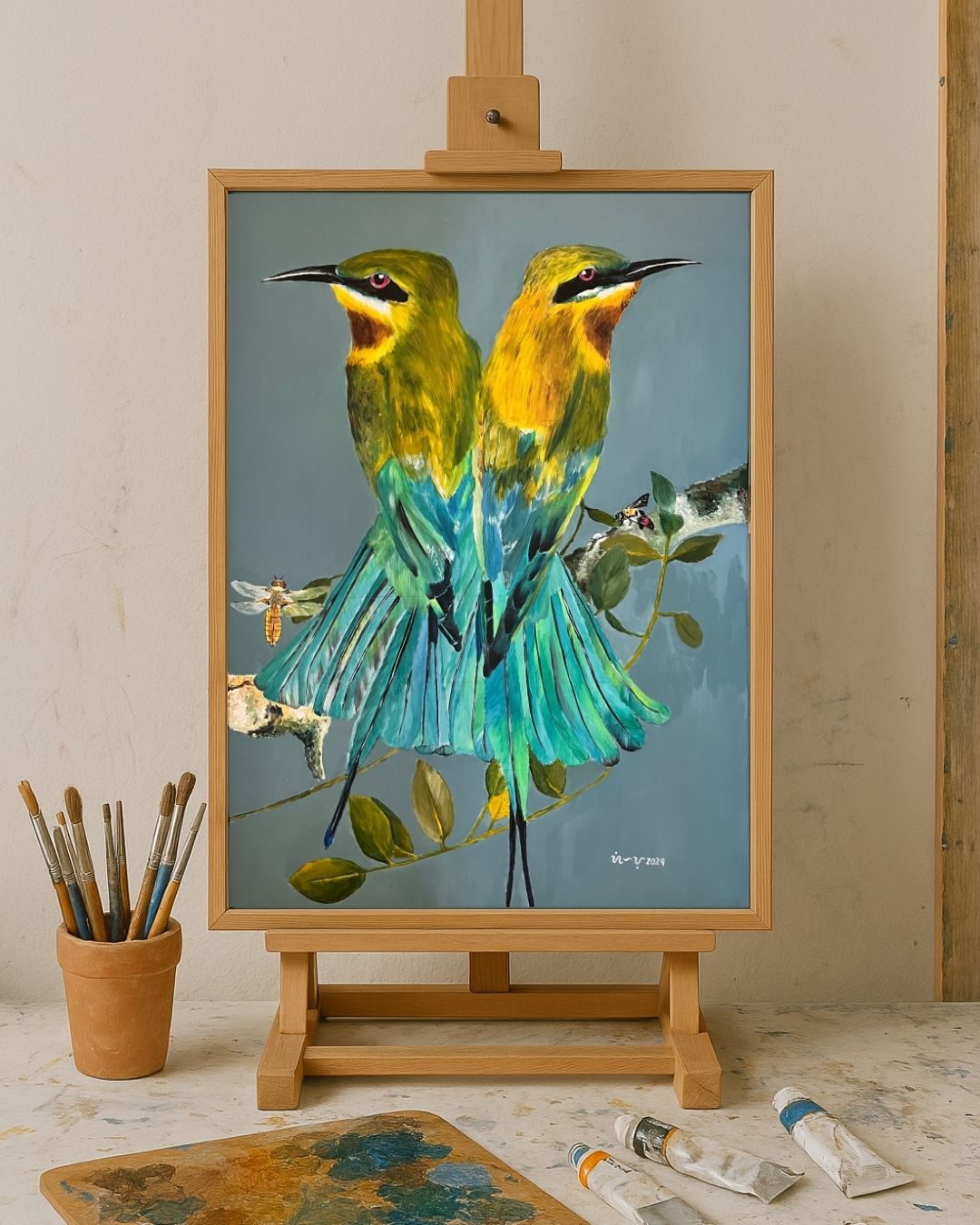
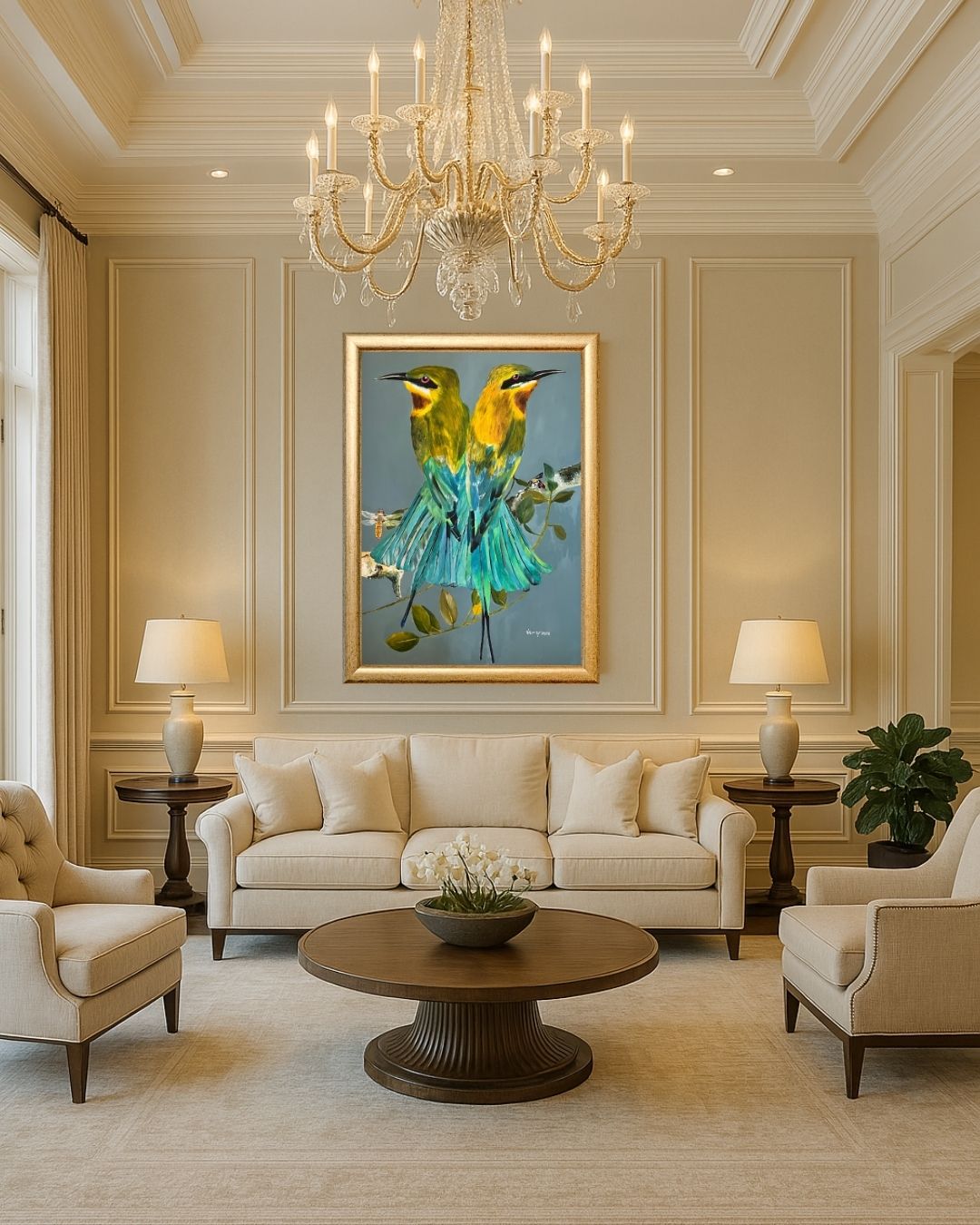
By Sihay| Acrylic on Canvas | 2024
“Fleeting Stages of Bliss” — Sold to my collector
Across the shimmering skies of South and Southeast Asia, especially in the Philippines, the Blue-tailed bee-eater (Merops philippinus) paints fleeting streaks of green, blue, and gold. These aerial acrobats, known for their lithe bodies and iridescent plumage, weave through the air with a dancer’s grace—yet with a hunter’s purpose.
In my painting, Fleeting Stages of Bliss, I sought to capture one of those rare, almost imperceptible moments where movement and stillness intersect. Two bee-eaters, locked in a mirrored posture—tails arched, bodies aligned, eyes alert—exist briefly in a state of perfect symmetry. Their positioning suggests more than readiness; it suggests intent, kinship, rhythm. It’s a portrait not just of birds, but of a shared instinct.
More Than Beauty: Ecology in Motion
Bee-eaters are aerial insectivores, known for catching bees, wasps, and dragonflies mid-flight with remarkable accuracy. Watching them hunt is to witness calculated spontaneity—each maneuver purposeful, each dive balletic.
Their Latin name tells part of their story. “Merops” means bee-eater in Greek, a nod to their diet and hunting prowess. “Philippinus” highlights their significant presence in the Philippine isles. Although they are not endemic, they are seasonal visitors whose arrival marks a natural rhythm in the archipelago. They pass through our coasts, riverbanks, and rice fields—flashes of iridescence amidst the changing winds.
These migratory patterns, like much of nature’s choreography, are easily missed in our fast-paced lives. But if you pause long enough, you begin to see: the bee-eaters are not just part of the landscape. They are part of a memory system encoded in the land and skies—markers of ecological balance, biodiversity, and the subtle shifts in seasons.
Painting as Witness
As an artist and science communicator, I often ask myself: What does it mean to bear witness through painting? For me, it is to translate field notes into brushstrokes, to turn observation into emotion. In this piece, every feathered detail was chosen not just for aesthetic effect, but for anatomical truth. The gesture of the wings, the direction of the gaze, the bend of each talon—all rooted in close study.
But representation isn’t enough. My goal is to evoke the feeling of motion. To remind viewers that what we see is just one stage of a longer story—migration, courtship, feeding, vanishing. My hope is that viewers leave with a deeper appreciation for both the visual and the ecological poetry of these creatures.
Why It Matters
In a time of increasing habitat loss and climate change, birds like the Merops philippinus are indicators of larger environmental trends. Their presence—or absence—can tell us much about the health of our ecosystems. Through art, we can make these realities more visible. We can create space not just for admiration, but for inquiry and care.
When you look at a Blue-tailed bee-eater, you see more than color. You see precision. You see movement. You see a living thread in the fabric of a much larger, and more fragile, ecological web.
Follow more stories behind the canvas at #SihayStudio.
Let art be your lens into the wild world around us.
 Sihay
Sihay 
Leave a comment